


I know an agency owner who nearly killed their business at $1.2 million in revenue.
The problem wasn't the market. It wasn't the team. It wasn't even the clients.
The problem was them.
They were personally approving every client email. Every decision ran through their calendar. Every problem landed on their desk. They had built a business that couldn't function without them in the middle of everything.
Sound familiar?
The Growth Ceiling Nobody Talks About
Most agencies hit a wall between 10 and 15 clients. This happens because the scrappy systems that got you to $300K become the exact things preventing you from reaching $1M.
But here's what the data doesn't capture.
The real constraint isn't your systems. It's you.
When a founder's intuition becomes the final word in every decision, growth stalls because throughput is limited to the founder's availability. You don't own a business at that point. You own a very demanding job.
I've seen dozens of agency owners completely abandon their 12-month strategic plan because they're getting sucked into business as usual and constantly putting out fires within the team or having to front up to clients and explain why things aren't working as promised.
Why The Fires Keep Starting
Three things cause most of the chaos:
Scope creep. Agencies say yes to clients without accurately scoping out projects. The client has expectations in their mind. The agency has different expectations. Never the two shall meet. When the client doesn't receive the outcomes they expect, they start asking questions the agency can't answer because mutual expectations were never communicated and put on one page.
Unclear roadmaps. The team doesn't know what they're supposed to be working on. There's no clear roadmap for each client project or campaign.
Missing SOPs. A lack of standard operating procedures means team members cut corners or make things up on the spot. That leads to inconsistencies.
But here's the question that matters.
Why does the owner become the one who has to fix these fires instead of the account manager or project lead? What's broken in the structure that makes it escalate to the top every time?
The Real Problem: Task-Based Management
No one cares about your agency as much as you do because you own the business and you're taking all the risk. It's your reputation and your finances on the line.
What's really missing is that team members are not responsible for delivering outcomes. They're responsible for following systems and completing tasks.
If they were responsible for delivering outcomes, they would deliver the outcome and make sure it never gets escalated to you. But if they're following a pre-designed process that predates their employment, they just blame the system.
If they're not responsible for delivering outcomes on a job scorecard, they're just doing their job. They're following the task. They're following the system. But the system's broken and they don't have a sense of ownership.
What A Job Scorecard Actually Looks Like
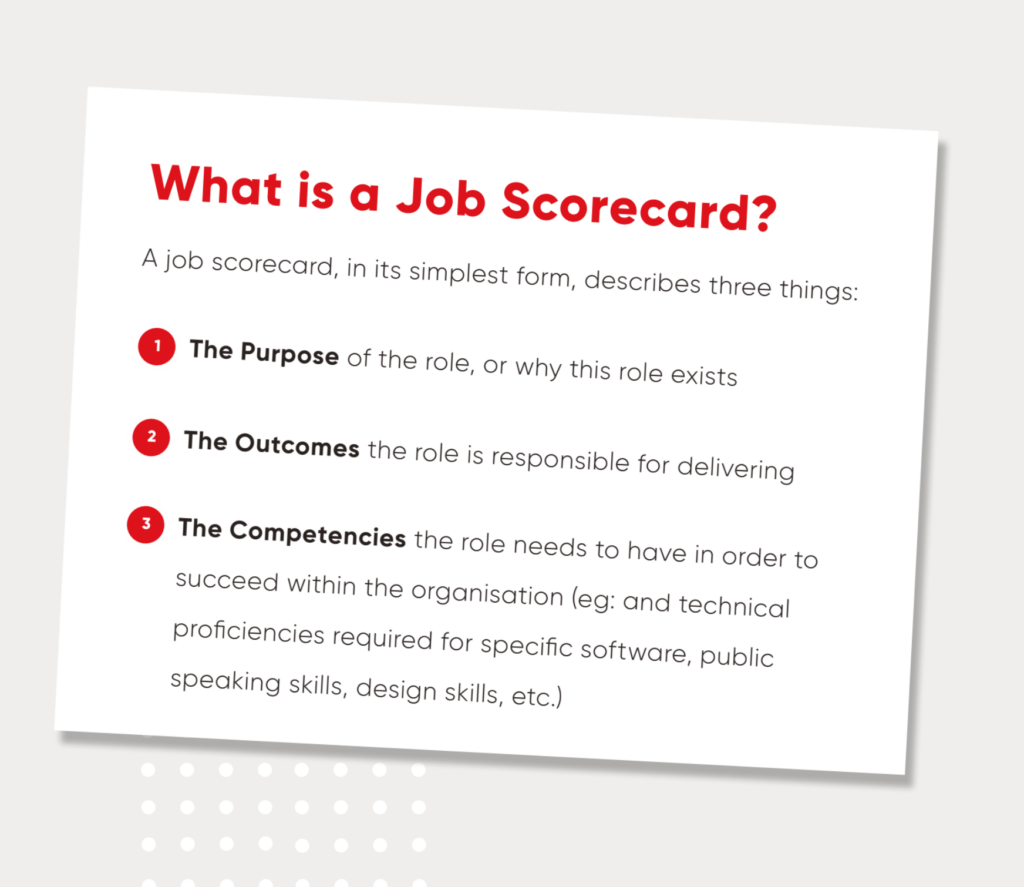
A job scorecard has outcomes at its core. It describes the outcomes and quantifies the outcomes that the role is responsible for delivering.
That's different from a job description, which describes how someone will do the job.
Here's a concrete example.
Typical job descriptions for account managers say things like delivering campaigns on time and within budget, sending weekly reports to each client, scheduling regular client calls to give status updates.
A job scorecard with outcomes clearly says that an account manager is responsible for retaining 95% of clients and making sure less than 5% churn every quarter.
If they're focused on that outcome, they'll figure out all the other stuff they need to do. They'll build relationships with clients. They'll make sure the agency's getting the results that were promised. They'll make sure the sales team aren't over-promising in the first place. They will bridge whatever gap needs to be bridged to make sure that client doesn't churn because that's the outcome they're responsible for delivering.
It's also easy to have a conversation about behavior and performance when they're not aligned with the outcome they're responsible for delivering. They can do all the tasks and perform the job as per the job description and still not get the outcome because the system, the tasks, and the job description are not accurate.
The other thing about job scorecards with outcomes is that it gives the person in that role a sense of ownership for figuring out the best way to achieve that outcome while staying within the values of the agency.
Research backs this up. A meta-analysis of seven studies involving 1,080 participants found that outcome accountability improves performance in complex tasks, while process accountability only helps with simpler tasks. For complex agency work, holding people accountable for outcomes like 95% client retention is more effective than task-based accountability.
The Fear That Stops You
Most agency owners think they're unicorns and that no one can do it as good as them.
The truth is you got your agency to where it is today by doing the thing. What stops you from growing is releasing that control and trusting your team to deliver outcomes.
The shift here is to hire overlings, not underlings. As the agency owner, you should be the dumbest person in the room.
I know this may be unpopular with a lot of people reading this, but if an agency owner is obsessing over CSS or direct response copywriting or which social media software they should be using to post on behalf of their clients, then they're not an agency owner. They're really a freelancer with some hired help.
Where To Start: Your First Strategic Hire
Most agency owners are jacks of all trades. They're pretty good at a lot of things. They're generalists. Maybe they started out as specialists, but if they have more than three staff, they're now generalists.
You should hire people who are really good at the creative or technical aspects that you deliver for clients. Be impressed by the AI tools that your developer is using and how fast they're delivering landing pages. Be impressed by the beautiful work that your new designer is delivering for your clients. Be impressed by the high converting emails that your new copywriter is writing for your clients.
Once you see a team member outperform you, it unlocks the mindset and you start asking questions like, what would happen if I was surrounded by people who were more talented than me?
Your job then as the agency owner becomes about casting the vision to the whole team, giving the team what they need to succeed. And yes, focusing on business development, asking the questions about where this agency needs to be positioned in the next three years to navigate what's happening in the landscape. How do we continue to grow? Who's our next JV partner? Is there a potential acquirer that we can sell to? Is there another agency that we can buy? Who do we need to hire next?
These are the questions that an agency owner should be thinking about.
The Practical First Step
Design an org chart for what the agency needs to look like in 12 months' time. It can be a team of three or a team of 30.
Imagine what the agency looks like in 12 months when you're not doing all of the things. Map that out on a future-facing org chart. Then start to work through which role it makes sense to hire first and develop a job scorecard for that role.
You should be hiring to supplement your weaknesses. Look at the tasks you're doing in the agency at the moment that you are the weakest at or that you don't enjoy or that frustrate you. Hire for that role.
One of the first roles I hired for was a developer because I got to a point where I realized I wasn't a very efficient developer even though I enjoy writing code. There were other people that could do it faster and better than me. So I relinquished control of that function and we hired a developer.
That freed me up to then think about growing the business and bringing on more clients. As soon as I saw that developer producing better work than me faster, I started thinking, great, who can I hire next?
How To Avoid Micromanaging
The mistake a lot of agency owners make is they hire someone and then try to train that person how to do the job.
We're not a community college. We're a business.
You need to hire people who know what they're doing and have them bring their process to your agency. It's impossible for you to document all of your processes before you hire people. Even if you end up with a team of five, there's one of you and four of them. How can you possibly document their jobs before you hire them? You just simply don't have the time or the expertise.
One thing you do need to document is what done looks like. What is the gold standard? For example, when we add a blog functionality to a client's website, what does that look like? What does done look like? What's the gold standard? What's the tech stack that we use? Where is it hosted? What are the non-negotiables?
But we don't document the process of actually doing the job. We let an experienced developer come in and teach us their process. We don't hire five developers at the same time, so we don't have the problem of five developers doing things five different ways.
We hire the first developer. They bring their process. They document it. Then they will become the team lead and hire other developers to work under them and follow their process.
Five opinions are better than one as long as you have one person who is responsible for ultimately making the decision and one person responsible for delivering the outcome.
When You Know It's Working
There's a specific moment when you know the transition is complete.
It usually happens when the owner is so bored that they start getting their hands dirty and they start getting in the way and they start causing problems and the team get frustrated.
We see this happen all the time. At that point, it's our job to pull the owner out of the way, get them to sit down, relax, enjoy the view for a moment and actually realize that their agency is delivering value and creating a profit without them being involved in every single decision of the day-to-day.
It's very obvious when an owner feels irrelevant or that they've been made redundant in their own business because they start projects and they start to break things. They need to feel important.
By the way, this is the fastest way to demotivate and derail your team.
Just give your team everything they need to succeed, and then get out of the way and wait for them to ask questions.
What Strategic Leadership Actually Looks Like
The first piece of advice we give owners at this stage is to actually get out of the building. Physically leave your office. If you're in a building with your team, get out of the building and go and do other things. Go and network with other business owners. Take up a hobby. Just have a rest. Give yourself a moment and an opportunity to think about what you want to do next.
The team needs clarity and stability. The way we provide that for the team is we have a very clear vision about where the agency is going and why the agency exists. We have very clear values which govern our decision making. This is how we know that the team will make the same decision that we would make if we were in the building.
And we have a very tactical and ambitious mission. So everyone on the team knows why they get out of bed every day and come to work.
For example, our mission is to find one digital agency owner every day that we can help. That's a very simple mission through which all of our decisions are made. That is the lens through which we see our work. One digital agency owner every day that we can help. That directly aligns with our vision, which is to be the most helpful team on the planet for digital agency owners.
The Reality Check
Here's what the data tells us about what happens when you don't make this shift.
Research from Lehigh University found that 87% of founders reported experiencing anxiety, depression, or burnout. Many entrepreneurs work 50 to 60 hours per week, often more during the startup phase, and entrepreneurs who struggle to set work-life boundaries are almost three times more likely to experience high burnout.
Agencies lose about 38% of their clients every three years. 37% of agencies note client acquisition as their top challenge, and 20% list time constraints as their top challenge.
Poor decision-making and unclear processes cost British firms an estimated £84 billion annually. Over 60% of UK small businesses never grow past £1 million in turnover due to unaddressed bottlenecks.
The bottleneck stage is a test of whether you can transform from operator to owner. Most fail.

What To Do Tomorrow Morning
This may sound like a grade school exercise and I know a lot of small business owners resist this for a long time because they don't see the value in it, but you need to document your north star.
The vision. The values. The mission.
Why does the agency exist other than to employ people and make money? What are the values, the core beliefs that you share that govern your decision making? And what is your mission? What are you actually doing in the next 12 months to help bring your vision to life?
If you have a team that are aligned around your vision and your values and are actively engaged in completing the mission, you become unstoppable.
The agency owner at $1.2 million who was approving every email? They made the shift. They documented what done looks like. They hired their first A-player. They built job scorecards with outcomes. They got out of the building.
Their agency kept growing. They didn't.
That's the whole point.