

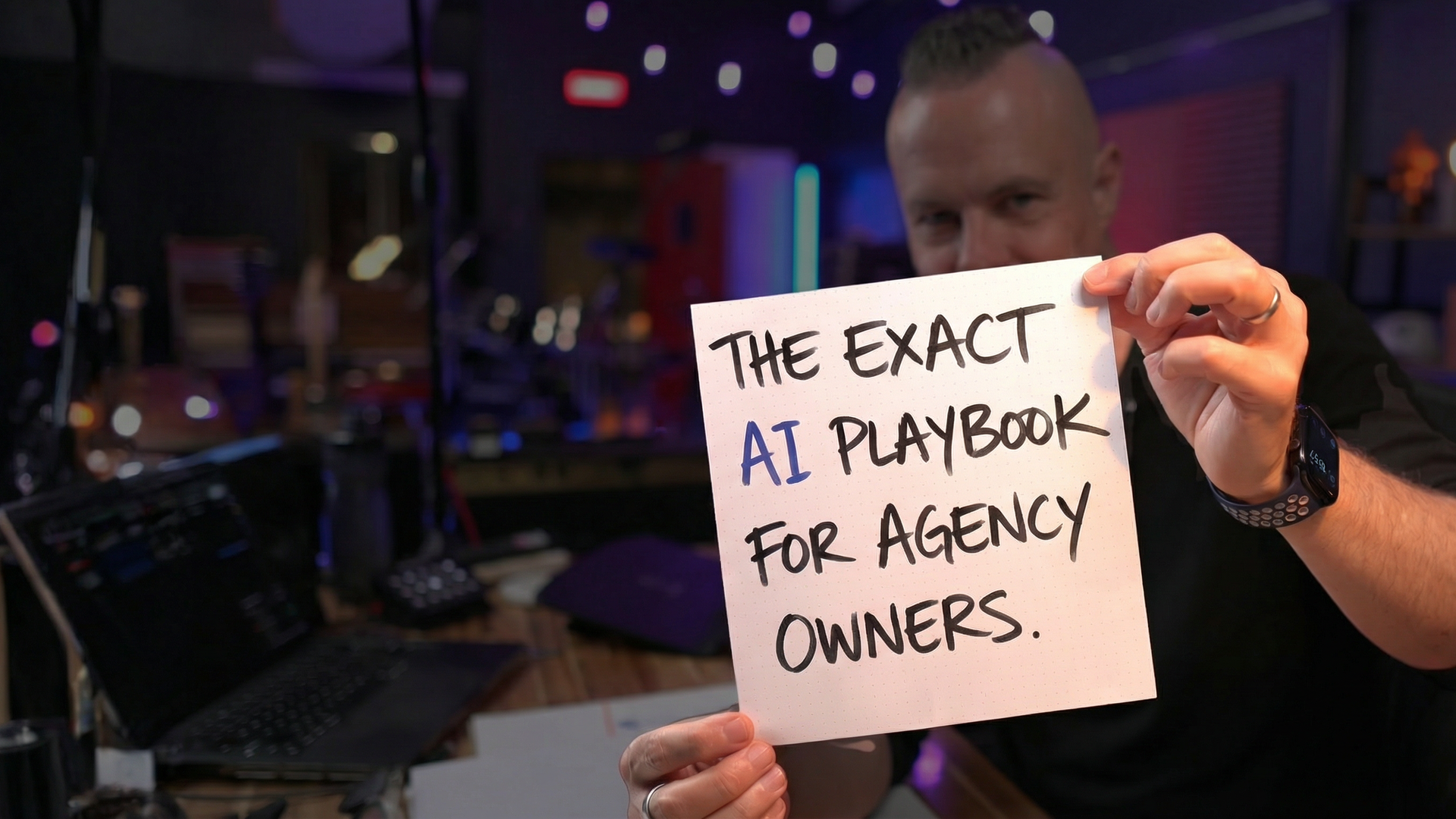
Every digital agency owner is saying the same thing right now. They know they should be using AI. They just don't know where to start. ChatGPT, Claude, Perplexity, Manus, and whatever launched last Tuesday. The tools keep multiplying and nobody has time to figure it all out because they're too busy working in the business, serving clients, managing the team, trying to grow.
This is the AI agency automation playbook. No hype. Nothing to sell. Just a clear framework for deciding what to hand to the machines, what to keep human, and the order in which to do it. If you're a digital agency owner, this was built specifically for you.
You're Doing Computer Work (And You Need to Stop)
Take a step back and look at what's actually happening in your agency every day. Smart, experienced people, entrepreneurs with 5, 10, 20 years of expertise, sitting in front of a computer and inputting data. Waiting for the computer to spit out something on the other side. Human beings doing computer work.
You're the one with the experience. You're the one who's been inside your clients' businesses helping them overcome problems and grow. And you're copying and pasting data into spreadsheets. Copying data from one platform to another to send a client report.
Come on.
You should be sitting across from your clients. Listening to them. Empathising with them. Helping them design strategies and solutions. That's the work. Everything else is prep.
Think of your agency like a great restaurant. Every great restaurant has a prep cook. Someone who cuts the vegetables, crushes the garlic, labels the containers, gets the spices ready. The chef doesn't want to be julienning carrots. The chef wants to do what the chef does best, which is create something brilliant under pressure for the people in the room. AI is your prep cook. Let it prepare everything so you can go in and do what you do best: have a human relationship with another human.
AI Is Not Going to Put You Out of Business
Before we get into the framework, let's kill the panic.
Remember when WordPress came along? Every web developer freaked out. “We're out of a job.” More agencies sprung up than ever. Same thing happened with page builders. “Everyone can build their own website now.” More agencies sprung up than ever. The same thing is happening with AI.
Go down the street and talk to a local business owner. Ask them how much time they have at the end of the day to go home, learn to vibe code their own website, figure out how to use AI to run ad campaigns, or plug into some data API for keyword research. They'll look at you like you've lost your mind. They're a vet, or a plumber, or a restaurant owner. They don't have time and they don't want to learn.
Business owners will always want to talk to other business owners who can help them solve problems. Their accountant, their lawyer, their marketing strategist, their business coach. Human beings trust other human beings. That trust is something machines will never replicate. And that's your job. Let the computers do the computer work and free yourself up to do the human work.
The Three-Tier Framework: Automate, Augment, Protect
Every task in your agency falls into one of three tiers. Once you understand which tier a task belongs to, the decision about AI becomes obvious.
Tier 1: Automate
These are tasks where a human is currently inputting data into a computer and expecting output from the computer. Admin. Reporting. Scheduling. Data entry. Follow-up emails. Client onboarding forms. Chasing invoices. Producing invoices. Producing proposals from templates.
Any time you're putting data into a computer and the computer is outputting that data in a different format, that's a Tier 1 task. Hand it to the machines as fast as you can.
You don't need to overhaul everything at once. Find one or two key tasks that you repeat over and over again each week. Just one or two. Automate those. Then find the next one.
This is the base of the pyramid and it's where you start. The stuff that isn't client-facing. Internal admin. Onboarding. Staff training documentation. Job scorecards. Org charts. Planning your weekly WIP meeting agenda. Planning your one-on-ones. That kind of thing. Completely automatable, and it should be automated.
Tier 2: Augment
This is where AI and humans work together. AI does the heavy lifting, but a human makes the final call.
Content drafts are a good example. AI might write 85% of a blog post and then a human comes in, reviews it, tweaks it, adds their perspective, and hits publish. Or think about a paid discovery session. You take the transcript of a client call, put it into AI to generate a strategic roadmap for the next 12 months, but you don't just hand that over. You run your eyes over it. You add your experience, your insight, your understanding of the client's specific situation. Then you present it.
AI handles the preparation. You bring the judgment and the relationship.
Tier 3: Protect
These are the tasks you never automate. Strategy. Creative direction. Client relationships. Sales conversations. Coaching calls. The moments where another human needs to feel seen and heard and valued and acknowledged.
This is where your clients stay for three, four, five years. This is where you earn your fee. This is where you justify what you charge.
The agencies trying to automate everything in this tier end up with AI slop. Quality goes down. Clients notice. The whole thing falls over like a house of cards.
Protect the high-value human work.
The Simple Test
For every task in your agency, ask one question: is this a human talking to a computer, or a human talking to a human?
If it's a human talking to a computer, it's Tier 1 or Tier 2. If it's a human talking to a human, it's Tier 3. Protect it.
The Mistake Most People Make With Their Free Time
There's a trap that catches almost everyone who starts automating.
You give AI a task. You end up with some extra time. And then you spend that time trying to give AI more and more tasks. You go deeper into the technology instead of stepping away from it.
Wrong move.
The time you get back from AI should go into Tier 3 work. More client conversations. More strategic thinking. More incubation time.
Think about where you come up with your best ideas. Not staring at a screen. It's in the shower. Going for a walk. At the gym. Driving the car. Nobody ever says “I had my best idea staring at a spreadsheet.” Take the time AI gives you back and protect it. Get away from the technology. Give your subconscious the space to come up with creative solutions to the problems you're actually facing.
The Uncomfortable Truth About What Comes Next
When AI completely takes over the computer work, and we are moments away from that happening, what's left for the humans?
The answer is one that a lot of people find uncomfortable: your job is to become a thought leader.
Not in the spammy LinkedIn buzzword sense. What it means is this: if you're a service provider selling intangible things like websites, marketing, financial planning, or contracts, you need to be prepared to take the thoughts in your head and share them with the marketplace.
It doesn't have to be video. Doesn't have to be a podcast. It could be blog posts, emails, Twitter, whatever works for you. But if you're not willing to share your experience and the data that backs it up, it gets very difficult to justify charging for the computer work when the computer can do it on its own.
Your clients don't care whether you use AI or handwrite emails and scan them in. The only time they care about AI is if you're producing AI slop and charging a premium for it. What they do care about is that you understand their problems, you speak their language, and they trust you.
That trust comes from content. At some point, every client relationship traces back to someone sharing their ideas where other people could find them. You only need a thousand genuine followers who value what you have to say. Sharing your thinking is how you build that.
The most valuable person in this ecosystem is still the one who sits between the client and the gap in their knowledge. Between the client and the technology. Between the client and the complexity they don't have time to figure out themselves. That's your job. AI just makes you faster and more profitable at doing it.
Your Next Move
Don't overthink this. Look at what you're doing in the business this week. Find one Tier 1 task. One thing where you're putting data into a computer and waiting for output. Automate it. Then find the next one.
Free yourself up from the computer work. Spend that time on the human work. And start documenting what you know and sharing it online.
Do that consistently for the next three years and you'll have a steady flow of leads, a pipeline that doesn't dry up, and a business where you never have to wonder where the next client is coming from.
Take the Agency GPS scorecard. It takes about 10 minutes, it's free, and it'll give you a customised action plan for exactly what to do next in your agency based on your goals and your current situation.
Stop doing computer work. Start doing human work. Let's get to it.
Frequently Asked Questions
What is the best way to start using AI in a digital agency?
Start with Tier 1 tasks: repetitive admin work where you're inputting data into a computer and expecting formatted output. Client onboarding, reporting, invoicing, and scheduling are the highest-return starting points. Automate one or two tasks per week.
Will AI put digital agencies out of business?
No. The same panic happened with WordPress and page builders, and more agencies emerged each time. Business owners will always need human expertise to bridge the gap between their goals and the technology. AI makes agencies more efficient and profitable, not obsolete.
What tasks should a digital agency never automate?
Strategy, creative direction, client relationships, sales conversations, and coaching calls. Any task where the client needs to feel seen, heard, and valued by a human. This is where agencies earn their fees and retain clients for years.
How should agency owners spend the time AI frees up?
On Tier 3 work: client relationships, strategic thinking, and incubation time. The biggest mistake is spending freed-up time giving AI more tasks instead of stepping away from the screen to think about the bigger problems in your business.
Why do agency owners need to share their ideas online?
When AI handles all computer work, the differentiator becomes your thinking, experience, and perspective. Clients hire service providers they trust, and that trust increasingly comes from content. You only need about a thousand engaged followers to build a thriving pipeline.