


I had a sales call last year with someone who quoted my podcast back to me. Word for word. They'd been listening for months, watching on YouTube, taking notes. They joined our high-ticket program that same week.
That episode had less than 500 views.
Most content creators would call that a failure. I call it proof that we're measuring the wrong things.
The Vanity Trap Is Killing Your Business
Here's what nobody tells you about viral content. It brings the wrong people.
Stockton Walbeck, founder of Course Creator 360, watched one of his Instagram videos hit 3 million views. It gained 50,000 followers. It generated zero leads and zero sales. Another video with just over 4,000 views produced qualified leads and thousands in revenue.
The difference wasn't the content quality. It was who watched it.
I'm not in the business of monetising content through page views or brand deals. I use content to nurture my audience and build trust with digital agency owners. That's it. If 99.99% of people who view my content are never going to be clients, I don't care about watch time.
I care about being helpful to the 0.01% who matter.
Why CFOs Don't Trust Marketing Metrics
According to Viant research, 36% of CFOs cite the use of vanity metrics by CMOs as a top concern. When you can't prove value in dollars and cents, budgets get cut and credibility erodes.
The structural problem runs deeper than bad measurement. Platform algorithms and content gurus systematically push you toward broad reach instead of targeted authority. They tell you to “grow your audience” and “increase engagement” because those metrics are easy to track.
They're also meaningless for your business.
I've stopped talking about generating leads and getting to your first $10,000 month. I talk about hiring A players, fixing operations, and removing the founder from the agency. That content attracts our ideal clients and filters out nascent agency owners who are still driving for Uber.
The filtering is the point.
The Math That Actually Works
You're running a business. How does “if it helps one person, it's done its job” generate revenue?
The sustainability comes from the motivation structure. If I create content to chase likes and followers and I don't get them, I get deflated and stop creating. If I create content to be helpful, I can keep doing it regardless of the numbers.
That consistency compounds.
Viral content lasts 72 hours. A well-optimised piece of educational content can generate traffic for 3-5 years. One creates a spike. The other builds infrastructure.
I mention digital agency owners in the first 30 seconds of every piece of content. That's my filtering mechanism. It tells people who aren't my target audience to move on. Some ignore that and watch anyway. They end up on sales calls telling us they run recruitment agencies or real estate agencies.
We politely decline.
Leaving Money on the Table Is Strategy
Most business advice says turning away paying customers is stupid. I say it's the only way to build real expertise.
Our business is built around one thing. We're becoming the most helpful team on the planet for digital agency owners. They're the only people we serve. Yes, I'm leaving money on the table. But it allows us to stay focused, streamlined, and lean.
It gives us deep understanding of the specific problems digital agency owners face.
These days, the only people we interview on our podcast are our clients or our strategic partners who serve digital agency owners. Our YouTube videos are me teaching digital agency owners one specific thing. We stopped interviewing big names for reach.
Our content metrics took a dive.
Our pricing went up. The quality of our clients went up. The sales cycle got shorter. I stopped wasting time chasing people just because I wanted a big name on the podcast, even though they were completely irrelevant to my audience.
According to research from P&G's strategic shift, they moved from generic demographic targeting to more than 350 precise smart audiences. CEO David Taylor said this eliminated wasteful mass marketing. They used their 1 billion+ consumer IDs to build targeted segments for each brand.
If P&G can do it, so can you.
The Two Types of Content That Matter
There are only two types of content you should produce to attract clients:
Educational content
Social proof
Everything else is vanity driven by your ego.
I see service business owners publishing daily motivational quotes, trending topic commentary, and personal stories about their morning routine. None of that builds authority with your ideal clients. Some people just want to be famous on the internet. They want to build a huge personal brand for its own sake.
I want to help our target audience as much as possible.
There's a difference between being helpful to anyone who stumbles across your content and being strategically helpful to people who can become clients. I shifted from talking about lead generation to talking about operational architecture. That topic shift filtered out the wrong audience and attracted the right one.
I had a sales call last year with someone who quoted my podcast back to me. Word for word. They'd been listening for months, watching on YouTube, taking notes. They joined our high-ticket program that same week.
That episode had less than 500 views.
Most content creators would call that a failure. I call it proof that we're measuring the wrong things.
The Vanity Trap Is Killing Your Business
Here's what nobody tells you about viral content. It brings the wrong people.
Stockton Walbeck, founder of Course Creator 360, watched one of his Instagram videos hit 3 million views. It gained 50,000 followers. It generated zero leads and zero sales. Another video with just over 4,000 views produced qualified leads and thousands in revenue.
The difference wasn't the content quality. It was who watched it.
I'm not in the business of monetising content through page views or brand deals. I use content to nurture my audience and build trust with digital agency owners. That's it. If 99.99% of people who view my content are never going to be clients, I don't care about watch time.
I care about being helpful to the 0.01% who matter.
Why CFOs Don't Trust Marketing Metrics
According to Viant research, 36% of CFOs cite the use of vanity metrics by CMOs as a top concern. When you can't prove value in dollars and cents, budgets get cut and credibility erodes.
The structural problem runs deeper than bad measurement. Platform algorithms and content gurus systematically push you toward broad reach instead of targeted authority. They tell you to “grow your audience” and “increase engagement” because those metrics are easy to track.
They're also meaningless for your business.
I've stopped talking about generating leads and getting to your first $10,000 month. I talk about hiring A players, fixing operations, and removing the founder from the agency. That content attracts our ideal clients and filters out nascent agency owners who are still driving for Uber.
The filtering is the point.
The Math That Actually Works
You're running a business. How does “if it helps one person, it's done its job” generate revenue?
The sustainability comes from the motivation structure. If I create content to chase likes and followers and I don't get them, I get deflated and stop creating. If I create content to be helpful, I can keep doing it regardless of the numbers.
That consistency compounds.
Viral content lasts 72 hours. A well-optimised piece of educational content can generate traffic for 3-5 years. One creates a spike. The other builds infrastructure.
I mention digital agency owners in the first 30 seconds of every piece of content. That's my filtering mechanism. It tells people who aren't my target audience to move on. Some ignore that and watch anyway. They end up on sales calls telling us they run recruitment agencies or real estate agencies.
We politely decline.
Leaving Money on the Table Is Strategy
Most business advice says turning away paying customers is stupid. I say it's the only way to build real expertise.
Our business is built around one thing. We're becoming the most helpful team on the planet for digital agency owners. They're the only people we serve. Yes, I'm leaving money on the table. But it allows us to stay focused, streamlined, and lean.
It gives us deep understanding of the specific problems digital agency owners face.
These days, the only people we interview on our podcast are our clients or our strategic partners who serve digital agency owners. Our YouTube videos are me teaching digital agency owners one specific thing. We stopped interviewing big names for reach.
Our content metrics took a dive.
Our pricing went up. The quality of our clients went up. The sales cycle got shorter. I stopped wasting time chasing people just because I wanted a big name on the podcast, even though they were completely irrelevant to my audience.
According to research from P&G's strategic shift, they moved from generic demographic targeting to more than 350 precise smart audiences. CEO David Taylor said this eliminated wasteful mass marketing. They used their 1 billion+ consumer IDs to build targeted segments for each brand.
If P&G can do it, so can you.
The Two Types of Content That Matter
There are only two types of content you should produce to attract clients:
Educational content
Social proof
Everything else is vanity driven by your ego.
I see service business owners publishing daily motivational quotes, trending topic commentary, and personal stories about their morning routine. None of that builds authority with your ideal clients. Some people just want to be famous on the internet. They want to build a huge personal brand for its own sake.
I want to help our target audience as much as possible.
There's a difference between being helpful to anyone who stumbles across your content and being strategically helpful to people who can become clients. I shifted from talking about lead generation to talking about operational architecture. That topic shift filtered out the wrong audience and attracted the right one.
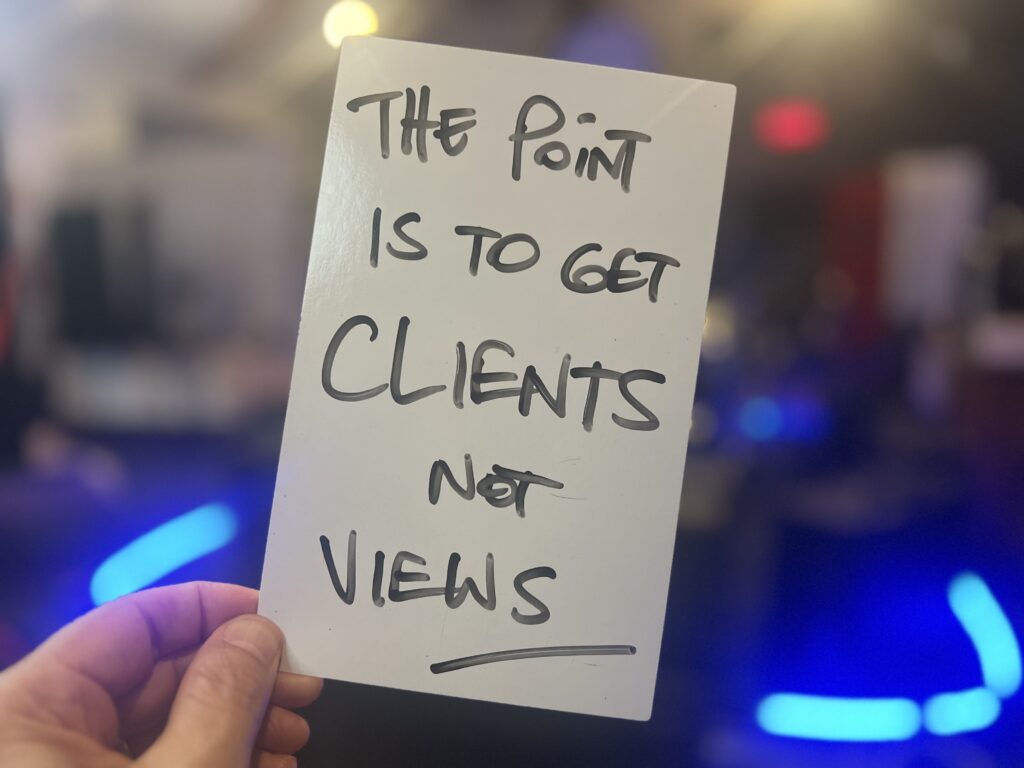
What I Actually Measure
I don't look at follower counts.
We send emails to people in our sales pipeline asking them to watch specific content on YouTube or listen to our podcast. They quote our content back to us on sales calls. That's how I know our content strategy is working.
According to B2B buyer research, buyers consume up to eight vendor-created pieces of content before making a buying decision. But 66% say vendors provide too much material, 57% say much of it is useless, and 58% say it's focused more on style than substance.
You don't need more content. You need better content for the right people.
Quality beats quantity every time. 1,000 highly relevant followers generate infinitely more business value than 10,000 random followers who never engage or convert. Your bank account will thank you for remembering that.
The Psychological Friction
You can see these results and still struggle to ignore vanity metrics. The friction is real.
Platform algorithms reward broad reach. Content gurus teach you to optimise for engagement. Your peers are posting about their viral moments. The entire ecosystem pushes you toward measuring the wrong things.
Breaking that pattern requires a different motivation structure. If your why is “I want to be helpful to digital agency owners,” you can create content sustainably. If your why is “I want likes and followers,” you'll burn out the first time a piece doesn't perform.
I've been there. I know what it feels like to watch a piece get ignored while someone else's generic post goes viral. The difference is I stopped caring about the comparison.
Content as Infrastructure
Stop thinking about content as a marketing expense measured in engagement metrics. Start thinking about it as architectural infrastructure for credibility.
Every piece you publish is a building block. It compounds over time. It creates asymmetric value exchange. Someone can consume hours of your expertise before they ever talk to you. When they do reach out, they're pre-qualified and pre-sold.
That's the compounding effect of authority-based content versus the diminishing returns of viral chasing.
According to research on B2B content marketing, 70% of marketers prioritize content quality over quantity. Long-form content generates 3x more leads than shorter content but receives 40% fewer total views.
The trade-off is worth it.
The Implementation Framework
Here's what changes when you shift from metric-chasing to authority-building:
Filter in the first 30 seconds. Call out your target audience explicitly. Let everyone else know they can move on.
Talk about operational problems, not aspirational outcomes. Stop teaching people how to get their first client. Start teaching them how to remove themselves from operations.
Interview clients and strategic partners, not big names. Your podcast isn't a reach tool. It's a credibility tool.
Measure quotes on sales calls, not views. If prospects are referencing your content, it's working.
Turn away wrong-fit clients. Population selectivity creates economic value by deepening your expertise.
Publish educational content and social proof. Everything else is ego.
The behavioural shift is simple but difficult. You have to stop caring about what everyone else is measuring. You have to build conviction that helping one person with one thing is enough.
That conviction becomes sustainable when you see the business results.
Build Authority, Not Audience
Your content strategy should optimise for client quality, pricing power, and sales cycle length. Those are the metrics that matter for a service business.
Vanity metrics feel good in the moment. They give you something to post about. They make you feel like you're making progress. But they don't correlate with revenue, and they don't build the kind of authority that attracts ideal clients.
I stopped chasing views years ago. My business got better.
Stop creating content for people who will never buy. Start creating content that builds systematic credibility with the people who matter. Filter aggressively. Publish consistently. Measure what actually drives revenue.
The math works when you're focused on the right people.