

For decades, we've built companies around a simple assumption: if you want more output, you hire more people.
That assumption is breaking.
AI agents, wearables, voice interfaces, and headless software are changing the way businesses operate. The question is no longer how many people work for you. The question is how much value each person can create.
🎧 Listen to the episode:
You have been lied to about the future of work. Not in a dramatic, conspiracy-theory way. In the quiet, insidious way that happens when everyone around you nods along with an idea that stopped making sense eighteen months ago.
The lie sounds like this: hire more people, build more systems, grind harder, sleep less, scale the team, add another office, celebrate headcount milestones like they are victories instead of confessions.
I am fifty-two. I have watched friends die at forty-six, at fifty-two, at fifty-six. They left behind young kids, half-built businesses, plans they never got around to. I am not interested in building a monument to busyness. I am interested in what works right now. And what works right now is radically different from what worked even two years ago.
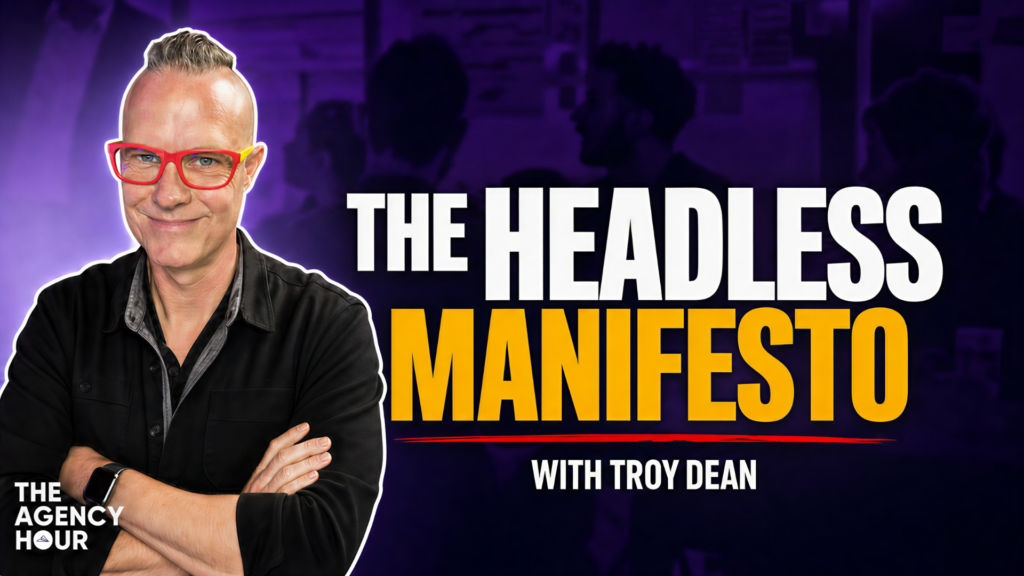
I laid all of this out in The Headless Manifesto on a recent episode of The Agency Hour. If you have not read it yet, start there. If you want the practical version, the one that tells you what to do about it, keep reading.
Headcount Was Never a Measure of Success
Somewhere along the way, “how many people work for you?” became the proxy question for “how successful are you?”
That question is broken.
A fifty-person agency doing five million with a burnt-out founder is not winning. A twelve-thousand-person corporation where eight thousand of those people sit in meetings about meetings is not winning either. A solo operator doing a million dollars with their weekends back is not losing.
We have been measuring the wrong thing for so long we forgot we picked the metric.
Watch how founders introduce themselves at events. “We are forty-seven people now.” “We just crossed two hundred.” “We have got three offices in three cities.” Nobody says, “Our margin is seventy-eight percent,” or “I work twelve hours a week,” or “We ship the same output we shipped two years ago with a third of the staff.”
Those are the numbers that matter. They are the numbers nobody brags about, and we have trained ourselves to read them as less serious.
Every headcount announcement is a press release for a problem you could not solve. Every “we are hiring” post is a confession that whatever system you have built does not work without more humans inside it. Hiring is what you do when you have run out of ideas about how to do it differently.
Payroll is the most expensive form of procrastination ever invented.
Hustle Culture Was Sponsored Content
Rise and grind was a sales pitch dressed up in motivational quotes by people who needed you to work harder so they could get richer. The men who told you to sleep when you are dead were either lying about how much they slept or actively destroying themselves on camera as content.
Half of them are dead now. The other half are in therapy.
Hustle culture turned suffering into a status symbol. If you were not exhausted, you were not trying. If you were not burnt out, you were not ambitious. If you were not sacrificing your kids’ school plays, your partner’s birthday, your own health, you did not really want it.
And the wildest part is how many of us bought it. Smart people. Thoughtful people. People who would never tolerate this logic in any other part of their life. If a personal trainer told you the only way to get fit was to never sleep and resent everyone you loved, you would find a different trainer. In business, somehow, it sounded like leadership.
I have a young family. I do not want to work sixty hours a week. I refuse to be the guy at school pickup who is there in body and gone in his head, running a Q3 forecast in his mind as his daughter shows him a drawing of a dog. I have watched too many people I respected do that for thirty years and end up with money, a stranger’s marriage, and kids who do not call.
The brag of the next decade is the unhurried one. Anyone still telling you to grind is selling you something. What they are selling is your own life back to you in instalments.
SOPs and VAs Were a Workaround, Not a Solution
A generation of business owners read The 4-Hour Workweek and built their entire operating philosophy on it. Document everything. Hire cheap labour in emerging economies. Train them up. Delegate yourself out of the business. Live free.
It almost never worked.
Every founder I know who tried it has the same stories. The VA who quit after six months and took the SOPs with them. The team that needed four AM calls and daily handholding. The Loom videos nobody watches. The Notion docs that turned into graveyards. The Trello boards filled with cards nobody moved. The endless cycle of hire, train, hope, replace that ate more founder time than just doing the work yourself.
I have coached agency owners through every version of this for fifteen years. I have tried every version of it myself.
The SOPs we wrote were documentation of a system that did not exist yet. They were hope dressed up as process. The VAs we hired were humans we trained to do work that could be done by software. Software that does not quit, does not sleep, does not take its training with it when it leaves, does not ghost you for a slightly better offer in month seven.
Tim Ferriss wrote a good book. That book was right for 2007. We have been running that playbook for twenty years. Nobody had a better one.
Now we do.
What “Headless” Actually Means for Your Business
The word headless comes from software architecture. In software, headless means the back end (where the logic and data live) is separated from the front end (the screen humans look at). The head is the interface. Headless software does not need a human staring at a screen to do its job.
For twenty-five years, using software meant a human in a browser. Clicking buttons, filling forms, reading menus, squinting at dropdowns. Every SaaS company on earth spent billions designing screens for humans to stare at for eight hours a day. Humans were the only entity that could read the screen and decide what to do next.
That assumption just died.
AI agents do not need to know where the button is. They do not scroll. They call the function directly. The user interface becomes one of many ways to access the system, and it is quickly becoming the slowest one.
Every major software company on the planet is already making this move:
- Salesforce announced Headless360 at TDX2026. Every layer of the platform is now open to AI agents through APIs and Model Context Protocol servers. Sixty new MCP tools shipped at launch.
- Meta shipped its first-party Meta Ads MCP server in April 2026. Google shipped Google Ads MCP. Amazon shipped Amazon Ads MCP.
- Anthropic created the Model Context Protocol in late 2024 and open-sourced it. By December 2025, it had ninety-seven million monthly SDK downloads and ten thousand active servers in production.
- The protocol is now governed by the Linux Foundation, with founding members including Anthropic, OpenAI, Google, Microsoft, AWS, Block, and PwC.
When the biggest software companies on earth spend billions removing the requirement for a human to click a button, they are telling you where the work is going.
If software is going headless, the businesses that run on software go headless too. Same architectural principle, one layer up. Separate the strategic layer from the execution layer. Let machines handle execution. Let humans handle strategy.
A headless business decouples what should happen from how it gets done. The human decides the what. The AI handles the how.
The New Metric: Value Per Human
The unit is no longer headcount. The unit is value per human. One person producing the output of ten.
It works at every scale:
- A solo operator running a million-dollar agency with no staff is headless. One human, the value of ten.
- A five-person company doing twenty million with AI handling the work that used to take fifty people is headless. Five humans, the value of fifty.
- A Fortune 500 division that delivers the same output with a tenth of the headcount it had two years ago is headless.
- A government department processing claims with three caseworkers and an AI agent instead of thirty caseworkers in a queue is headless.
- A research lab where one PhD with the right tools does the literature review and synthesis that used to take fifteen grad students is headless.
Human strategy. Machine execution. Value per human as the measure. The shape of the work is the same in every case.
This is not a lifestyle play for tired founders looking to downshift. The companies that get there first will eat the lunch of the ones still hiring like it is 2019. The next Fortune 500 will be smaller, faster, and worth more than the current one. Some of them will fit in a single house.
What Changes When the Interface Leaves the Desk
If every business that can go headless does go headless over the next ten years, the consequences are enormous. Most of them are good.
Office buildings empty out. Not gradually. Quickly. Once a Fortune 500 no longer needs eight thousand of its twelve thousand people in seats, one floor empties, then another. Then the building. Then the block. The towers we built to warehouse humans for eight hours a day start looking like what they are: infrastructure for a problem we just solved.
Those buildings sit on some of the most valuable land in every capital city on Earth. Manhattan, the City of London, Tokyo, Sydney, Melbourne, Singapore. We dedicated those parcels to office work in the twentieth century. Cities needed it to function. They do not need to function that way anymore.
The interface is leaving the desk. Wearables, voice, AI agents in your ear. Most workers will not need a desk and a keyboard. The entire infrastructure of office work, the desks, the chairs, the monitors, the parking lots, the queue at the cafe, the morning commute, was built around an interface we are about to leave behind.
Knowledge workers get to think for the first time. For forty-five years, knowledge workers have spent every working hour inputting data into a computer using a keyboard and mouse, then waiting for the computer to output that data in a different format. We mistook that for thinking. It was clerical work in a nice outfit. The actual thinking, the part that makes a knowledge worker worth anything, got pushed to the edges of the day. Into the shower. Into the commute. Into the third whiskey at eleven.
For the first time in the history of office work, the work that requires a human gets to expand and fill the day instead of getting squeezed into whatever is left after the typing is done.
Who This Is For (and Who It Is Not For)
This is for the operator who already knew something was wrong.
The agency owner with twelve staff who keeps having the same conversation about the next hire and feeling sick about it. The executive who can see what is about to happen to her company and would rather lead the change than be replaced by it. The consultant who cannot believe what AI can already do and does not want to wait for his peers to catch up. The accountant who knows her practice can be three times more profitable and a tenth as exhausting if she just stops doing it the way she was taught.
If you are scared of putting yourself out there, if you are afraid of rejection, this is not going to work for you. You should be an employee, and there is no shame in that. Some of the happiest people I know have jobs.
If you want a magic prompt or a downloadable template that fixes everything in twenty minutes, this is not for you either. What I am describing requires you to do actual work as the system gets trained. After that, the system runs and you get your life back. The work upfront is real.
If your business plan is to scale to another five hundred employees and another building, go do that. It is a different game, and I am not playing it.
If you can see where the work is going and you would rather be early than right, you are in the right place.
FAQ
What does “headless” mean in a business context?
A headless business separates the strategic layer (human decisions) from the execution layer (AI-powered work). The human decides what should happen. The AI makes it happen. Success is measured by value per human, not headcount.
Do I need to fire my team to go headless?
No. Going headless is not about firing people. It is about not hiring the next ten. As AI handles more execution work, you redeploy humans to strategy, relationships, and creative work that machines cannot do.
Is the headless model only for agencies?
No. The headless model applies to any business that runs on software. Solo operators, mid-size companies, Fortune 500 divisions, government departments, research labs, and media companies can all apply the same principle: human strategy, machine execution, value per human.
What is Model Context Protocol (MCP)?
MCP is an open protocol created by Anthropic in 2024 that lets AI agents connect directly to software systems through APIs, bypassing the user interface entirely. It is now governed by the Linux Foundation and backed by every major tech company.
How do I start going headless in my business?
Stop writing SOPs. Start building skill files that an AI agent can read and execute consistently. Identify the work in your business that is clerical (data entry, scheduling, reporting, formatting) and move it to AI first. Keep human time for strategy, client relationships, and decisions that require judgment.
The Work Is Already Here
You have been running a 2007 strategy. It was the only strategy available. The world changed, and now you get to choose: keep running the workaround, or build the actual thing.
The infrastructure is funded. The protocol is open. The tools are live. The fifty-person agency model is on its last legs.
Headcount used to be the measure of a serious business. The new measure is value per human. We are not optimising the old world. We are building the next one.
If you want to see what a headless agency looks like in practice, explore the headless model here.