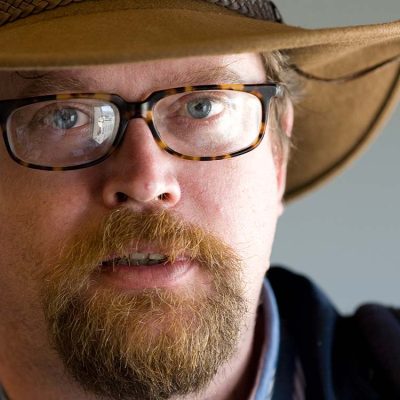
Our guest for today’s show, Hugh MacLeod, knows a thing or two about differentiating yourself, finding your niche, and going for it. If you’re struggling to find clients, or just interested in an inspiring story of one man’s unlikely path to success, then this is the show for you.
Hugh is giving away a copy of his book Ignore Everybody: and 39 Other Keys to Creativity for our prize today! To enter, just comment below and tell Hugh what is the hardest thing about your chosen profession. He will swing back in a couple of weeks to pick a winner and award the prize!
Hugh is a cartoonist, creative director and co-founder of Gapingvoid, a company that transforms business through art. He is intensely interested in what makes people tick, and combines that with the biggest part of most people’s lives: what they do for a living. This is why his artistic focus is on the work environment, instead of making art for people’s homes or other places. And he’s been hugely successful in doing so.
Growing up, unlike a lot of kids who wanted to be an athlete or an actor, Hugh thought he might like to become a cartoonist. And so he did! He really enjoyed drawing as a kid, and he also enjoyed reading Dr. Seuss and Peanuts and later, Doonesbury. By the age of 9, he was reading and drawing cartoons constantly.
Fast forward to 1995, it’s the early days of the Internet and the very pioneer days of blogging. As a struggling artist, he realized blogging was a tool that could help him earn a living by reaching people directly with his work.
He no longer needed to be “discovered,” as had always been the traditional path for an artist. He simply needed to find his 1,000 “true fans” ala Kevin Kelly, and he would be set. Blogging gave him a powerful medium to reach his audience.
Hugh believes passionately that the right location, the right office, the right layout, and the right décor can be incredibly powerful. And art is really the key. Art disrupts and drives behavior, because it bundles together our primary drivers as human beings: love, hate, fear, beauty, sadness.
There is much more to this episode with Hugh, be sure to tune in to hear it all!
Please join us in thanking Hugh for being with us today, and thanks to you as well for joining us. We’ll see you next time on WordPress Elevation.
Q: What’s the #1 thing any freelancer needs to know?
A: Know when to say no.
Q: What’s the best thing you’ve done to find new customers?
A: I started a newsletter. And go after the gigs nobody else wants. We weren’t interested in the guy who has a lot of money. We were interested in people with real problems.
Q: How do you stop competing on price?
A: We had very unique offerings so we didn’t have to. If you’re competing on price you’re not differentiating your offerings enough.
Q: Any tips for writing better proposals?
A: Be clear about what you want.
Q: What’s your favorite CRM tool?
A: Gmail and Basecamp is what we use.
Q: What’s the best way to keep a project and a client on track?
A: Practice! You have to be vigilant. Be realistic when setting deadlines. Build in time for unforeseen events. Constantly communicate with clients.
Q: Any ideas for getting referrals from existing customers?
A: Art is there all the time. It’s just hanging on the wall. People see it, and they ask “where’d you get that?”
Q: What’s the #1 thing you can do to differentiate yourself?
A: Go after a niche nobody else has thought of. Too many people are trying to sell the same stuff to the same people.
You can reach out and thank Hugh on his Twitter @hughcartoons or at his company’s website, http://gapingvoid.com/.
Hugh suggested I interview the CEO of MailChimp, Ben Chestnut. He’s super successful, a lot of fun and a real gentleman. Check your Inbox Ben – we’ll be sending you an invitation soon!
To enter the competition, just comment below telling Hugh the hardest thing about your chosen profession.
10 Responses
Hope you remembered to send Hugh some links to Leunigs work.
I think Hugh it it on the nose with the first response in the elevation round. Knowing when to say no is the hardest part as a consultant, especially when you have clients who bring scope creep but don’t want to pay for it.
The hardest thing for me is balancing being a business owner with being a designer/developer/unicorn.
I love both sides. But I feel like a juggler.
The hardest thing for me is balancing being a business owner with being a designer/developer/unicorn.
I love both sides. But I feel like a juggler.
By education, I am a scholar of an obscure literary period in another culture. So as a result, I ended up developing mad skills in several languages. And I have found that precisely those language skills transferred to almost everything else I have ever done to earn money. And it’s the tough part: to really get to what the customer wants to convey and to relay that to the audience so it will be properly understood and received. Words, images, and technical tools are all just means to that end. So if I’m doing a translation of a press release or I’m building a website, if I don’t really understand both ends of the equation, I may as well flush my skills down the toilet.
Hey Hugh, Troy and everyone… this is an easy question. The hardest thing bout my work is that I stared online in 1991 when there was really no World Wide Web.That’s not difficult of course. The difficulties began when I started making websites in HTML–especially back then when there was no VERSIONING (and it wasn’t even an idea I could consider). Later Java appeared. I wanted to learn that but it required REAL programming. Then JavaScript appeared and it was almost as easy to hack away at as HTML. Still not so difficult. Then VRML appeared and promised us that the entire Internet would become a 3D, vector graphic looking world that we could move around in with a mouse. I got halfway through building a magazine stand in a virtual shop and gave up. Then a 1997 client asked if I could take their HTML website and connected it to their MS Excel and spreadsheet data. I told them I could and spent the night in the bookstore reading seven books so that I could pick one to help me get the job done. Then ASP, ASP.NET, ASP.NET for Windows Forms (a corp gig) on MS SQL, and DotNet.Nuke on the side. Then XHTML, DHTML, CSS, and XML.Then ASP.NET C# for a more huger corp gig with 18 national websites running on Telerik Sitefinity, and MOSS and WSS SharePoint, as well AS MS SQL and Oracle SQL (eff me). Then PHP for an intranet, JSON and friends. And then social media where everybody *MUST* use it but like gold mining–the only people making money in this vast, global shell game are the people selling the picks and shovels, mules and gold pans. For me it’s a simple answer–every new day brings a new technology, a new language and new versions of languages. I’ve had to pick up, learn, hack and drop so many through my years that I can’t wait to one day use only pencils and notecards. At least until they come up with a way to have versioning there.